Theory "Roles in Scrum"
The three main roles
As you learned in the story at the beginning, there are some major differences between traditional and agile project management. First and foremost, always keep in mind that in Scrum there is no project manager. Instead, in the world of Scrum there are three central roles, which we will introduce to you in this chapter. Familiarise yourself with the Scrum Team, which consists of the following:
-
Product Owner
-
Scrum Master
-
Developers
The Product Owner, the Scrum Master, and the Developers work together to create the best possible product. For you, as a member of the Scrum Team, this means that you will go through many Sprints together with your team and deliver many Increments to create the optimal product. Always remember the goal of Scrum: in each Sprint, usable and potentially shippable outcomes (e.g. software) should be created.
Each Scrum Team member has a specific task during the project which is defined within the Scrum framework:
| Product Owner ... | Developers ... | Scrum Master ... |
|---|---|---|
| ... is the customer or their authorised representative in the project (i.e., their representative or proxy). | ... are specialists in different fields, and are therefore cross-functional in their composition. | ... acts as a coach and team developer for the Developers. ... ensures that Scrum is promoted and practiced in the company. |
Good to know
None of these three roles is superior or subordinate to any other role. Neither the Scrum Master nor the Product Owner has authority over the Developers or the overall management of the project.
Product Owner
When you work in the Scrum framework as a Product Owner, your goal is to ensure that the client's ideas and requirements are incorporated into the project and that the value of the work result is maximised. You hold sole responsibility for this. Management will provide you with support and access to project-relevant information if necessary.
As a Product Owner, you may carry out tasks related to the Product Goal and the Product Backlog yourself, but you may also delegate the tasks to other team members. However, in the end, you alone are responsible for the results - whether you were involved in the implementation or not.
The Product Owner ...
... must be an approachable, natural person. Neither a department, nor a committee, nor any other legal entity may act as Product Owner.
As a Product Owner, you are the manager of the Product Backlog:
-
You are responsible for the (potentially deliverable) added value of the product, the return on investment, in short ROI, and the economic success of the product.
-
You develop and communicate the Product Goal.
-
You are responsible for creating the Product Backlog entries, if necessary in the form of User Stories.
-
You prioritise and clearly communicate the Product Backlog entries.
-
You represent your stakeholders (e.g. customers and users) in different scenarios and are responsible for stakeholder management.
-
You develop the Sprint Goal together with the Developers.
-
Ideally, you are available to the Developers during the Sprint to answer any questions they may have.
-
You are responsible for approving of the Increments.
-
You have the authority to decide whether the Sprint should be continued or terminated.
In addition to these responsibilities and tasks, you should have certain skills as a Product Owner. Since you are responsible for the economic success of the product, an entrepreneurial mindset and business knowledge are required. In addition, you should have an eye for trends, because making important decisions is significantly influenced by your intuition and knowledge. Are you still at the beginning of your career? Do not worry! All these skills will be sharpened with increasing life and professional experience.
Developers
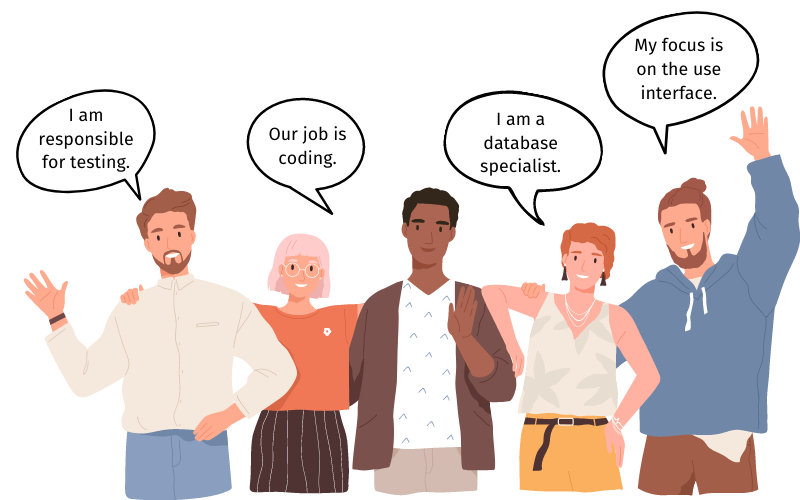
If you are a Developer, you and your team are responsible for producing usable Increments in each Sprint. The Developers are self-organised and make decisions regarding the creation of the product independently. All technical skills should be represented in the Developers' team so that the team is as cross-functional as possible. Similar to traditionally organised projects, Developers are usually drawn from the line organisation and return to it after the project is completed.
Your tasks as a Developer include:
-
Creating the Sprint Backlog (the planning basis for each Sprint) and negotiating with the Product Owner on the amount of work to be done.
-
Sharing responsibility for the Sprint Goal, i.e. for the results of each Sprint.
-
Delivering value and quality through adherence to the "Definition of Done" (DoD).
The highest goal of the Developers
Your highest goal, together with your teammates, is to develop at least one functional Increment per Sprint in order to complete the Sprint Backlog.
You and your team are
-
interdisciplinary (cross-functional),
-
(self-)responsible for the implementation of the tasks and
-
ideally consisting of 8 members or fewer (neither Scrum Master nor Product Owner is counted as part of the team unless they also contribute as Developers).
Scrum Master
Would you describe yourself as a servant leader? Then the suitable role for you is that of the Scrum Master. As a Scrum Master, you support an organisation in introducing and implementing Scrum. You are responsible for promoting and living Scrum as a framework. You ensure that everyone involved understands and can follow the theory, processes, rules, and values of Scrum. The Scrum Guide forms the basis for this.
Your task is to fulfill your agile leadership role as a "facilitator". This means your focus is on empowering and thus coaching others so that they can act successfully in the spirit of Scrum. You are responsible for the effectiveness of the Scrum Team by eliminating organisational impediments and external disruptions to the Scrum Team's workflow.
Your success depends on the success of the Scrum Team.
You ensure that everyone involved in the Scrum Team understands the Product Owner's scope. This includes understanding the goals and also the product domain. Regarding the Product Owner, your range of tasks includes the following:
-
Assisting the Product Owner in formulating the Product Goal, defining Product Backlog Items and, if necessary, the User Stories.
-
Supporting all Scrum events.
-
Assistance with prioritising entries.
-
Support and, if necessary, coaching on how to practise and live agility and empirical approaches.
-
Establishing techniques for effective management of the Product Backlog.
-
Promoting collaboration with stakeholders (facilitation), if desired.
Regarding the Developers, your task is to support the team in all matters and to help it grow into a successful team. Your main task is therefore to identify impediments and ensure that they are eliminated so that the Developers can achieve their overall goals. Further tasks are:
-
Coaching the team to become a "performing team".
-
Supporting the self-organisation of the Developers, so that they can make and carry out decisions on their own; the management concept applied is management by delegation.
-
Promoting (interdisciplinary) cooperation.
-
Ensuring that all Scrum events take place in an orderly manner (adherence to the time frame, positive and productive working environment).
-
Ensuring that all Scrum rules are followed.
-
If necessary: mediating between Developers and Product Owner.
Since you as Scrum Master are also responsible for introducing Scrum in the organisation, you will also have some tasks in this context. First of all, it depends on the degree to which Scrum, as a framework with its requirements and processes, is already established in the company.
-
How hierarchically is the company organised?
-
To what extent can responsibility be effectively delegated?
-
Is there already an understanding of this and is it therefore also possible to enable agile, empirical and incremental procedures?
Especially when introducing Scrum, this can mean encountering resistance and reservations. The corporate culture also plays a decisive role.
As a Scrum Master, you mainly enable the following in the company:
-
Communicating the procedures, goals, context, and mindset for agile approaches.
-
Acting as an organisational developer and implementing Scrum in the company, so that the framework conditions are given or, if necessary, improved.
-
Informing and coaching of employees, line managers, or responsible parties.
-
Assisting all employees and stakeholders in understanding agility as well as empiricism.
-
Reducing barriers between stakeholders and the Scrum Team.
In order to be able to master your tasks as well as possible, it is necessary that you already have experience in conflict management and that you drive change in the company as a change agent. Furthermore, you must be sociable and have a good network.
Role assignment in large-scale Scrum projects
In large-scale Scrum projects, it may be necessary or possible to have several teams of Developers working simultaneously. This is called Scrum of Scrums. In this case, a Scrum Master may supervise several teams simultaneously. The Product Owner role, however, is different, as each team is assigned a specific Product Owner designated for each sub-project. In this constellation, however, it is important to identify a Chief Product Owner who has overall responsibility and final decision-making authority over the other Product Owners.
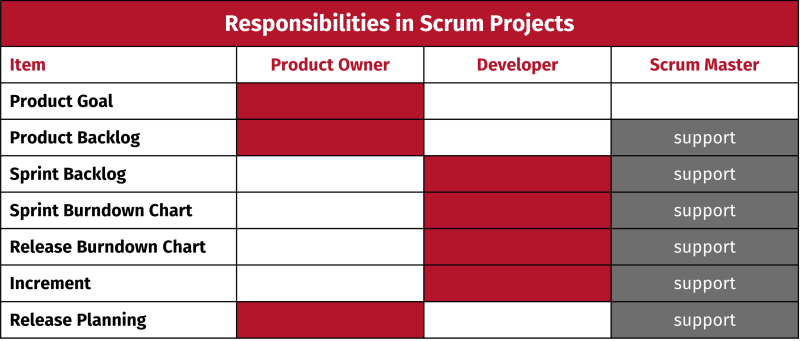
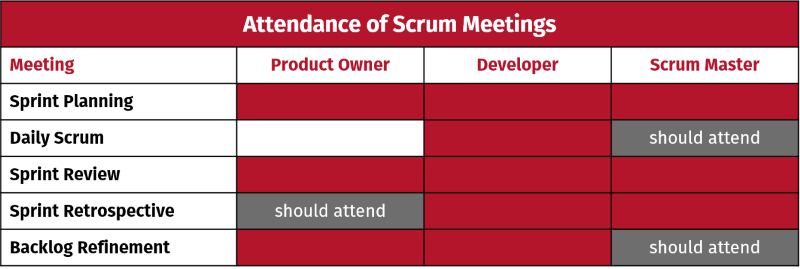
Responsibilities
Here you will find an overview of the different responsibilities in the Scrum Team, related to the different items, as well as attendance at Scrum events. At this point, you do not need to internalise the contents of these graphics, as they only give you an overview of the roles and responsibilities. In the course of the lessons, you will learn more about the listed items and about the meetings, so you should review these graphics again at the end.